
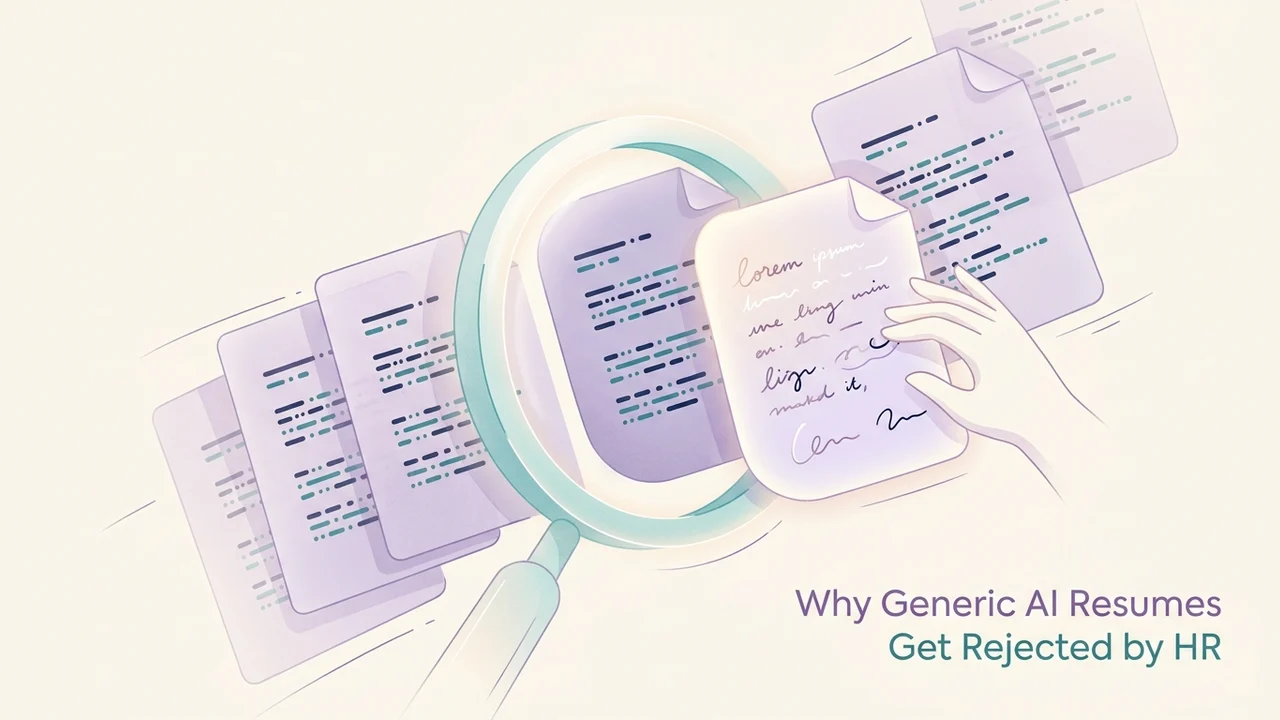
Why Generic AI Resumes Get Rejected by HR (And How to Fix Them)
Why Generic AI Resumes Get Rejected by HR (And How to Fix Them)
As artificial intelligence tools become standard in job application workflows, hiring managers and recruiters face a common problem: an influx of hyper-polished, virtually identical resumes. While generative tools make it effortless to draft cover letters and tailor work histories in seconds, relying on generic AI prompts often backfires.
Recruiters increasingly report that AI-generated resumes lack distinct professional voice and human context. When hundreds of candidates use identical prompts to mirror job descriptions, their applications blend together into a wall of buzzwords. Passing an initial Applicant Tracking System (ATS) scan is only the first hurdle—if your resume fails to demonstrate authentic achievement to human reviewers, it gets rejected.
Here is why generic AI resumes are failing in the hiring process, and how you can combine smart automation with authentic positioning.
The Fallacy of Over-Optimization
Many job seekers use AI to copy keywords directly from a job posting into their resume. While ATS software screens for relevant terms, over-optimizing creates several issues:
- Loss of Voice and Context: Generic generative outputs tend to use repetitive, elevated language without backing it up with specific details or measurable outcomes.
- Recruiter Fatigue: Talent acquisition teams review dozens of applications that sound like they were written by the exact same algorithm. Unique career stories get lost in standardized phrasing.
- Disconnection at the Interview Stage: When an application is generated entirely by an automated script, candidates often struggle during interviews to discuss achievements expressed in language they did not write.
Recent discussions among career coaches and recruitment specialists emphasize that while AI offers powerful drafting efficiency, over-reliance on one-click solutions dilutes candidate credibility.
Balancing ATS Compatibility with Authentic Experience
To stand out, your application must satisfy both automated screening algorithms and human hiring managers. Success relies on strategic alignment rather than blanket text generation.
1. Ground Content in Verifiable Data
Avoid letting AI invent narrative flair. Feed the tool concrete metrics—such as revenue growth, team size, project scope, or system efficiency gains—so the final output reflects your actual performance rather than boilerplate buzzwords. You can review our approach to structured resume evaluations on the Qlivik ATS Checker.
2. Tailor for Relevance, Not Just Keywords
Matching keywords is necessary, but relevance matters more. Instead of stuffing every keyword into a skills section, integrate relevant terminology into clear bullet points that explain how you applied those skills to solve problems.
3. Maintain Human Control
Treat AI outputs as preliminary drafts. Review every sentence to ensure it sounds like your voice and accurately reflects your professional background. If you want to explore more strategies on balancing automation with human control, visit the Qlivik Blog.
How Qlivik Protects Candidate Authenticity
At Qlivik, we believe AI should act as an assistant rather than a replacement for your professional identity. Qlivik hunts relevant job openings, analyzes role requirements, and helps optimize applications to clear ATS filters—all while keeping you in full control of the final submission.
By focusing on precise candidate-to-job matching, Qlivik ensures your true experience shines through without sacrificing search visibility. To learn more about our mission and ethical automation principles, read about us on Qlivik About or check our transparent plans on Qlivik Pricing.
Conclusion
Beating the ATS does not require sacrificing your authentic voice. By using AI tools thoughtfully—to analyze job descriptions, structure impact statements, and audit keyword alignment—you can pass automated screens while delivering a compelling, genuine story to human recruiters.